title

New Jersey Farm Bureau News


The USDA’s Natural Resources Conservation Service (NRCS) in New Jersey is accepting applications for the Agricultural Conservation Easement Program – Agricultural Land Easement (ACEP-ALE). Application packages are due by Feb. 28, 2026.

The ACEP-ALE program aims to protect the agricultural viability and related conservation values of eligible land by limiting nonagricultural uses of that land that negatively affect the agricultural uses and conservation values, and to protect grazing uses and related conservation values by restoring or conserving eligible land.

Applicants (eligible entities) must be a federally recognized Indian Tribe, state or local units of government, or a non-governmental organization. Applicants must have an established farmland protection program that purchases agricultural conservation easements for the purpose of protecting agriculture use and related conservation values by limiting conversion to nonagricultural uses of the land.

USDA provides up to 50 percent of the appraised fair market value of the conservation easement in this voluntary program and up to 75 percent for qualifying Grasslands of Special Significance (GSS). The qualified landowner retains ownership and continues to use the land for agricultural purposes.

To be eligible to receive ALE funding, eligible entity applicants must demonstrate a commitment to long-term conservation of agricultural lands; a capability to acquire, manage, and enforce easements; adequate staff capacity for monitoring and easement stewardship; and the availability of funds. All landowners of record and the land being offered for enrollment must also meet specific eligibility criteria as outlined in the application materials posted to the State ACEP website.

Fully completed application packets may be sent to the attention of Easements Program Manager, by email (preferred) to katelyn.colon@usda.gov or by mail to USDA-NRCS, 200 Clocktower Dr, Suite 101, Hamilton Square, NJ 08690.

Only fully completed and properly executed applications that are submitted by these signup dates on the appropriate forms and accompanied by all required supporting documentation will be considered for funding in FY 2026. All qualified applications will be reviewed, ranked, and considered for funding according to the Final ACEP rule, policy, and guidance. Complete applications received after the cutoff date may be considered if another sign-up date is announced. Incomplete applications will not be considered.

For more information about ACEP-ALE in New Jersey, please contact Katelyn Colon at (732) 537-6099 or katelyn.colon@usda.gov. You can also visit your nearest USDA Service Center or visit the New Jersey NRCS ACEP website.

Click here to read AFBF’s most recent Market Intel report on the farm economy and the next Farm Bill. 

Key Takeaways

The One Big Beautiful Bill Act (OBBBA) made significant modifications to USDA mandatory farm programs and the Supplemental Nutrition Assistance Program (SNAP). Following these changes, the Congressional Budget Office (CBO) now projects 10-year spending for farm and nutrition programs at $1.4 trillion.

Despite persistent low crop prices, high input costs and tight margins, current farm bill safety net programs delivered only about $2 billion for the 2024 crop year, according to CBO. With support from the OBBBA-enhanced programs not arriving until fiscal year 2027, many farms continue to face financial strain — making additional bridge assistance critical for weathering the upcoming growing season.

While OBBBA made a historic investment in farm bill risk management tools, several farm bill programs were left out, and Congress must still pass a bipartisan farm bill reauthorization to address those remaining gaps.

Farm Credit East, a member-owned lending and financial services cooperative, is currently accepting scholarship applications from high school seniors and college students with career aspirations in agriculture, commercial fishing and the forest products industries from across the association’s eight-state territory. Applications are due by March 19.

Farm Credit East’s annual scholarship is for students who are pursuing a career in agriculture, forest products and commercial fishing or a related field during the upcoming fall semester. Candidates must have a permanent home address within the area served by Farm Credit East and cannot be a past recipient. The $5,000 scholarship can be used to defray the cost of tuition, room and board, books, and other academic charges.

This scholarship application is currently open, and the deadline for submission is Thursday, March 19, 2026, at 5 p.m. ET. For more details or to apply for a Farm Credit East scholarship, please visit FarmCreditEast.com/Scholarship.

Brandon Raso, of Atlantic County, New Jersey, has been selected as a national winner in the 2026 National Outstanding Young Farmer Awards Convention (OFA), which will be celebrated the first week of February in Hershey, Pennsylvania.

Brandon Raso, recipient of the Outstanding Young Farmer Award, was honored during the 2026 New Jersey State Agricultural Convention for this accomplishment. Brandon was awarded due to his dedication to agriculture as a new generation farmer in the New Jersey blueberry industry, successfully operating an approximate 800 acres of blueberries and producing between 3.5 to 5 million pounds each year.

Click here to read more.

TRENTON, N.J. — On January 20, 2026, Governor Phil Murphy signed the New Jersey Invasive Species Management Act into law. The new law establishes a comprehensive framework and creates a permanent New Jersey Invasive Species Council to guide science-based policy, education, and management statewide. It restricts the unregulated sale, distribution, import, export, and propagation of designated invasive species while giving nurseries, growers, land managers, and municipalities realistic timelines to comply.

Twenty-two years in the making, grassroots advocates, scientists, and industry professionals changed New Jersey law. This legislation represents years of the tireless dedication of boots-on-the-groundwork by people who understood that New Jersey’s forests, waterways, and farmland were being systematically degraded by invasive species.

Click here to read more about the long history of invasive species legislation.

The following are some observations from NJFB staff after attending the American Farm Bureau Convention in Anaheim, CA.
  • H2A seasonal ag labor users would have been encouraged by numerous mentions during the convention of the attention being given to ag labor reforms. Aside from the win on the AEWR wage rate freeze already announced, the Trump administration DOL gives H2A application processing a high priority. Brian Pasternak of the USDOL Ofc  of Foreign Labor Certification on a Monday morning panel pledged their support in assisting grower applications. On Sunday afternoon, House and Senate Ag Comte chairs Thompson and Boozman said ag labor reform is among their 2026 priorities – showing a glint of hope after years of waiting.  Among the concerns is the escalating demand for a documented ag workforce amid all the pressure now created on immigration issues in the US. 
  • AFBF staff economist Danny Munch addressed a host of trade and commodity topics at his panel session on Monday morning. He said trade partners as a rule insist on certainty as a key ingredient in the ever-competitive world of farm trade. The US is struggling of late with this for a number of reasons, including “inefficient ” ports and vaciltating tariff rules. The US share of world ag trade has shrunk from 75% to 23 % since 1990. Munch also said on specialty crop expenses in the last five years have soared while risk management tools like crop insurance are scarce and therefore provide little or no safety net. Dairy farmers, in some instances, now find refuge from profit squeeze by selling their livestock for beef.  Even in California, wine industry operators report a generational change of less wine consumption together with other unwelcome market pressure. 
  • Stepping off the plane at LAX airport and walking outside to the Uber carport, a traveler noticed a sustained brisk wind that did not let up. On a bus tour the next day to Temecula, a California county Farm Bureau tour host identified that weather as the annual Santa Anna winds. It was those same winds last year that sustained the devastating wildfires in Los Angeles that the nation witnessed. “Had there not been heavy rainfall during the past few weeks,” he said, “those fires may have returned.” Not more than an hour later outside Anaheim, the countryside was green and rolling with hills. Beautiful to see. 
  • On the Tuesday NJFB tour, the group started off at Riverbed Farm. This aquaponics operation sits in the heart of Anaheim and helps contribute fresh and nutritious produce to those in need. This unique urban agricultural landscape was a great way for our farmers to see what it means to be an urban farmer and how small plots contribute meaningfully to the agricultural community in the state.


  • On the trade show floor, Gripp hosted an information session titled From Chaos to Control: Modernizing Farm Communication, which described the bottlenecks that arise from poor communication on farm and the need to streamline communications systems to one centralized platform. Communication is at the heart of any business; ensuring there are no breaks in the on-farm communication chain is critical. When one person is equipped with the tools to do technology-related work, etc., the lack of tribal knowledge by the rest of the staff can lead to inefficiencies. Sharing this tribal knowledge is the key to being effective as a farm enterprise.


  • To maintain the health of our farming economy in NJ and beyond, farmers must be able to compete in global markets. This can be achieved by keeping export markets open, such as that of the soybean industry. Global growth in the protein sector has underscored soy demand, as it is a major contributor to feed that supplies us with this protein. This increased market access will allow farmers in the US to stay competitive and remain viable.

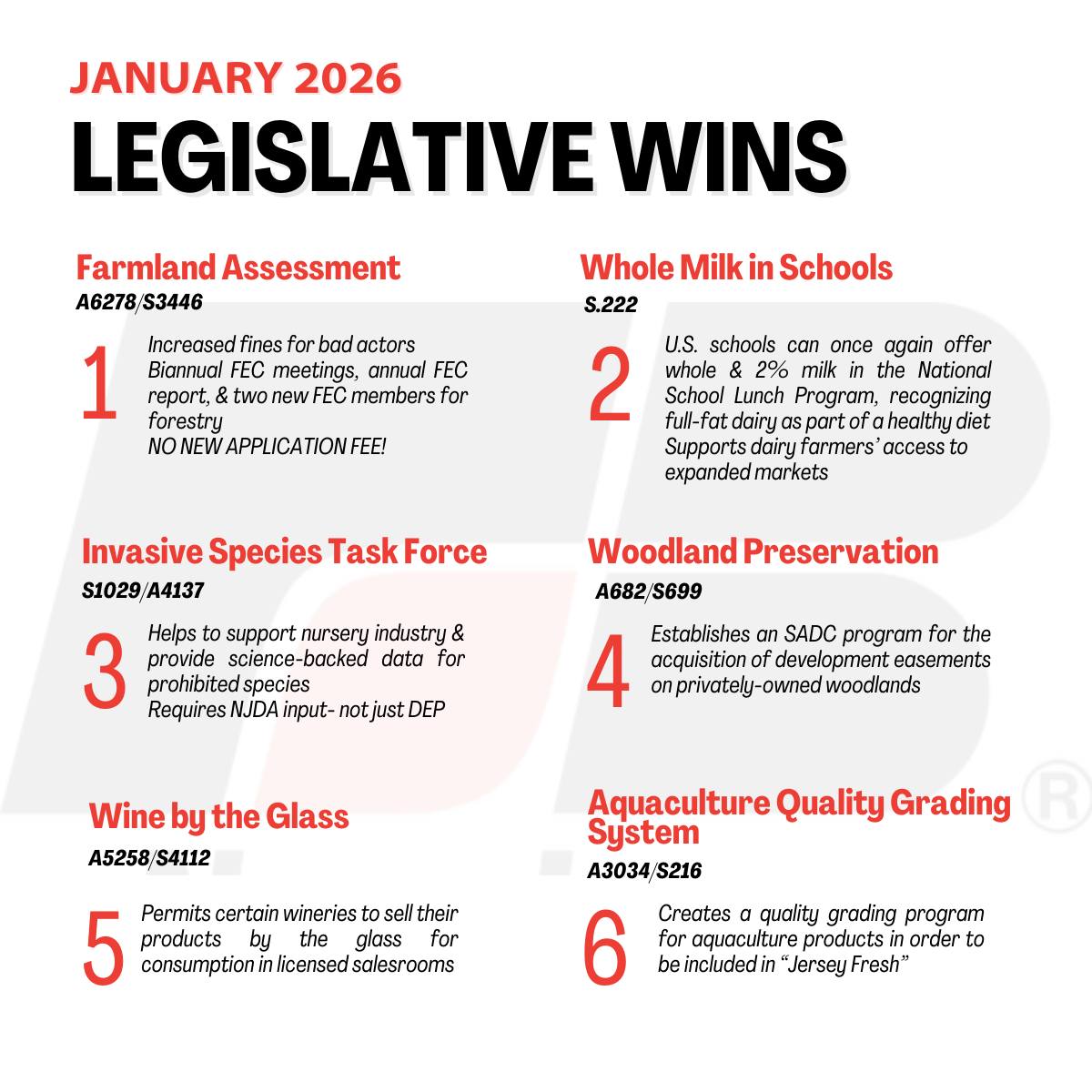
After months of negotiations, Governor Murphy signed S3446 into law, amending the farmland assessment statute.  The bill adds three new members to the Farmland Evaluation Committee (2 representing forestry and one public member) , establishes an online application portal and increases fines for those applicants who intentionally misrepresent information on their applications.

New Jersey Farm Bureau worked many hours to ensure the removal of a proposed application fee, ensuring that applying for farmland assessment will continue to be free for NJ farmers.

Click here for more information.